Saturday, February 25, 2012

Wiliwilinui Trail

On Saturday February 25, 2012 the Tree Huggers hiked Wiliwilinui Trail, the ridge above Kalani High School.
All Clean


At the top...all muddy

This was arguably the dirtiest The Huggers have gotten at an event and it was an opportunity to live up to the Tree Hugging name. Many participants hugged trees and ferns and/or the ground on this "official" hike---"official" meaning most everyone slipped in the mud at one point or another. Nina took the prize for the filthiest hiker of the day. The 'Ohi'a lehua trees were doing their best to gather or 'ohi the moisture in the air as we hiked through the mist and clouds.
Chester walking through the cloud

Sky using the rope to pull herself up the steep slope

There were many beautiful examples of native plants along the trail, too.

Some of the girls even took advantage of the opportunity of a free mud facial.

The day started out a little misty and rainy but by the time we all arrived at the top of the Ko'olau Mountains the clouds broke so we could get a little peek at Waimanalo as well as a view of the Honolulu side, especially on our way back down.


I'm very proud of all the participants who made it to the top. The trail and ropes were slippery and muddy but everyone stepped up to the challenge and had an awesome time. Good job, I hope the mud washed out of your clothes, and see you next month!

Thursday, February 16, 2012

Leeward Community College Visit

Thursday, February 9, 2012 a few Tree Huggers took a trip to Leeward Community College to help folks from the Wai'anae Mountains Watershed Partnership collect Pili grass (Heteropogon contortus) seeds.


Pili grass is an indigenous clumping grass that grows well in dry and moist conditions. It is now commonly used for erosion control but has been historically used for thatch. In Hawaiian, pili means to cling or stick. The seeds of pili grass twist, cling, and stick to each other in clumps. When the clumps get heavy they fall towards the ground. Using the spearhead or harpoon-like tips on the seeds, pili grass digs itself into the ground to start new growth. The seeds look a little like they are dancing as they dig themselves into the ground.

Since pili seeds have a six month dormancy, the seeds we collected today will be stored until they are ready to be planted in six months. The pili will be grown and used around the future site of the Mililani Middle School greenhouse as well as in the Wai'anae mountain range.

The Tree Huggers also got to see the greenhouse at Leeward Community College where many other native plants are growing, like this Alula (Brighamia sp.), an endagered and endemic species from Kaua'i and Ni'ihau.

The native pollinator of the Alula plants has gone extinct and people must hand pollinate plants in order to propagate the plants by seed.

Saturday, January 21, 2012

Kealia Trail

On Saturday January 21, 2012 MMS Tree Huggers, the few and the proud, hiked Kealia Trail.

It was a great day with beautiful views. We saw plenty of gliders flying by, skydivers jumping from planes, and whales playing right outside the sets rolling in to Mokuleia.
 The rocks from an old quarry were used to build the airstrip at Dillingham airfield. Now, what remains of the quarry is an aquaculture farm. The water is fresh water and the top of Oahu's fresh water table

The Tree Huggers successfully found and identified many plants along the trail, some native and others invasive. One of the native plants we saw was this Peperomia sp. 'ala'ala wai nui. It has many medicinal uses, particularly to cure feminine ailments in traditional Hawaiian medicine (La'au lapa'au).

Rest up Tree Huggers and see you next month on Wiliwilinui Trail!

Thursday, January 19, 2012

Project Noah

We will be observing and identifying plants (and potentially other organisms like mushrooms and insects) on our Kealia Trail hike this weekend. If you have a smart phone or a digital camera feel free to bring it with you. You can upload your observations to Project Noah, http://www.projectnoah.org/, a website affiliated with National Geographic. It is a tool to document and identify organisms and be citizen scientists.
There is a free app for android and iPhone users, too.

See you Saturday in your comfortable clothes with plenty of water and sunscreen!

Wednesday, January 4, 2012

Updates

The Kealia Trail hike has been rescheduled for Saturday Januaray 21st. Please meet at the front of the school if you are able to help carpool or if you need a ride.


The MMS Tree Huggers Club t-shirt is on sale now until Feb 2nd. Click on the link below for an order form.

https://docs.google.com/document/d/1Y6TEg_t9L9FoTkOWul5kIdAgPB-wGHb4wRm-PdJ_woc/edit

NOTE: The design came off the t-shirt in the link so it doesn't look right, but it will be on the shirts we order :)
The Tree Huggers Club t-shirt was designed by Mililani High School graduate, now artist living in New York City, Kristin deNeeve. Check out her website:  http://kristindeneeve.com/

Saturday, November 19, 2011

Malama Mokauea Fishing Village, O'ahu's last remaining fishing village

On Saturday November 19, 2011, a small group of the MMS Tree Huggers joined groups from Sacred Hearts, The University of Hawaii, and Hawaii Pacific University on a malama Mokauea workday. Mokauea Island is located in Ke'ehi Lagoon across from Sand Island (also known as Ka Moku Akulikuli), where we met up with Aunty Joni and Aunty Kehau.
Aunty Kehau and Aunty Joni welcoming the group

Tree Huggers and others listening attentively


Unfortunately, they were short handed on steersmen so it took a while to get everyone to the island.
Aunty Kehau demonstrating how to paddle with Mokauea Island in the background

But, once we arrived, Aunty Joni shared a little bit about the history of the island. Ke'ehi means "tread upon" and before the area was dredged (starting in 1941) for sea planes, to build the reef runway, and to expand Sand Island, residents used to be able to walk from Mokauea and the other islands in Ke'ehi Lagoon to O'ahu at low tide. Ke'ehi lagoon used to be a very productive fishery and was Kamehameha III's royal fishing grounds.

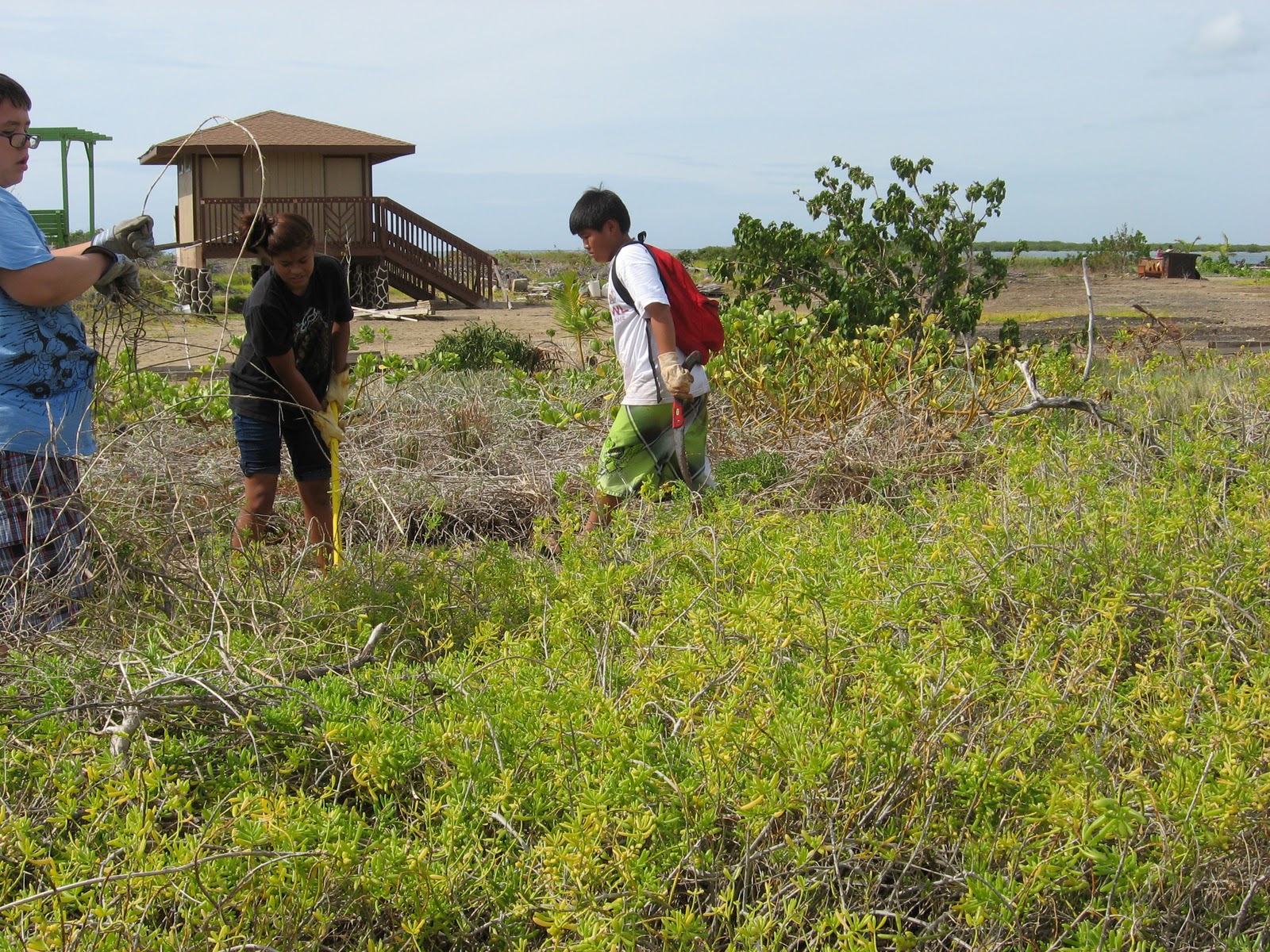
After learning about the history of Moakuea and the surrounding areas, the Tree Huggers got to work by helping to weed the native plant plot.
Dedicated members Brianna and Malia working hard to clear the pickleweed

Another dedicated hugger of trees, Amy, working hard and busy


More dedicated huggers, Thomas and Pikake battling the pickleweed


They focused on removing the invasive pickleweed plant. It is edible and has salty tasting leaves (salt retention is an adaptation to living in a coastal environment).
Pickleweed

It's native counterpart with a similar adaptation is considered to be the 'Akulikuli.
'akulikuli

After a quick, but successful attack on the pickleweed, The Tree Huggers moved on to do a quick marine debris sweep and view of the island.
Mr. Horstman says: It's "get the drift and bag it," not "catch the wind and bag it"

Looking for marine debris


It was high tide and some of the tree huggers in training would not have been able to make it around the whole island so we stopped at the end of the fishpond to discuss the mangrove and its adaptations and then headed back in the canoes.

A couple of in-training members


Loading the canoe and heading back to O'ahu


See you next month!

Sunday, October 9, 2011

Malama i ka 'aina, Pohakea Pass Road

On Sunday, October 9, 2011 Tree Huggers met up with Na Wahine o Kunia to help clean and uncover a Hawaiian burial site along Pohakea Road in Lihu'e o Kunia.
Aunty Leilehua describing the site and the pohaku before we began working

Mr. Hortsman mentally preparing for the day

Mrs. Cruz


Aunty Sheila, Leilehua, and Amy shared stories and history about the importance of the area. Pohakea Pass was used by Hawaiians for traveling to trade sweet potato grown in the Kunia area for fish from the Wai'anae side. You can see the profile of Pohakea in the mountain, the pass being the dip in the mountain or her neck area.
Pohakea Pass from Pohakea Road
Working Hard


The significant Hawaiian sites are potentially at risk of being damaged by the proposed thoroughfare and eventual industrialization of the watershed that would create a road connecting the Wai'anae side with central O'ahu through the mountain. The Tree Huggers helped  to do some important work to bring awareness to the various architectural sites and iwi.
The pile of grass and debris removed from the site

Before Shot

After Shot

After their hard work and a delicious lunch, the Tree Huggers helped to give offerings of lei and pa'akai.


Thank you for all your hard work!